Must-Read Articles: January Edition

“Ugandan Activist Named on Anti-Gay Hit List Found Murdered” – David Kato, a gay rights activist in Uganda, was found murdered in his home earlier this week.  Last year, his name, address, and photograph, appeared on a list of 100 gay men and lesbians living in Uganda.  This list was intended to incite violence, as evidenced by newspaper captions such as “hang them.”  This article offers great background information, up-to-date news on the current investigation, and more.

Stand with Brenda – As I just mentioned, life in Uganda is simply not safe for gay men and lesbians.  However, Brenda Namigadde, a lesbian from Ugandan, is likely to be deported from the United Kingdom tonight!  Eight years ago, she fled to avoid being “persecution for her sexuality;” if she is forced to return to Uganda, she will likely be harassed, tortured, or even killed.  Sign this petition as soon as possible to ensure that Brenda will be allowed to stay in the UK!

“How Abortion Bans Threaten Womens Lives”Roe v. Wade overturned the abortion ban in the United States in 1973, yet 38 years later, women are still seeking abortions in unsafe environments.  In this article, Patty Skuster and Susan Schewel highlight the reality of this situation by discussing the illegal abortions that were being performed in a certified clinic in Philadelphia.  Even when abortion is legal, there are still many barriers to access that lead women into dangerous, even deadly, situations.

“No Jail Time for Lawrence Taylor” – Lawrence Taylor, a former American football player, was found guilty of having sex with a sixteen year-old girl that was trafficked into the sex trade last year.  Read this article to learn more about Taylor’s sentencing and domestic sex trafficking.

“When the politically fueled murder of a 9-year-old girl in Arizona is NOT national news”

“Stop Murder and Violence Against Sex Workers” – A great article from On the Issues about the treatment of sex workers by the criminal justice system and society at large.

“My First Day as an Abortion Doula” – In sharing her personal experiences, Miriam Perez shows how important doulas are for women seeking reproductive health services.  This article is truly an inspiration!

“The House GOP’s Plan to Redefine Rape”

Interview with curators of “FORCE: on the culture of rape”

PShiftTV Exclusive!

An Interview with Jessie Fahay: Feminist Activist and Theater Director

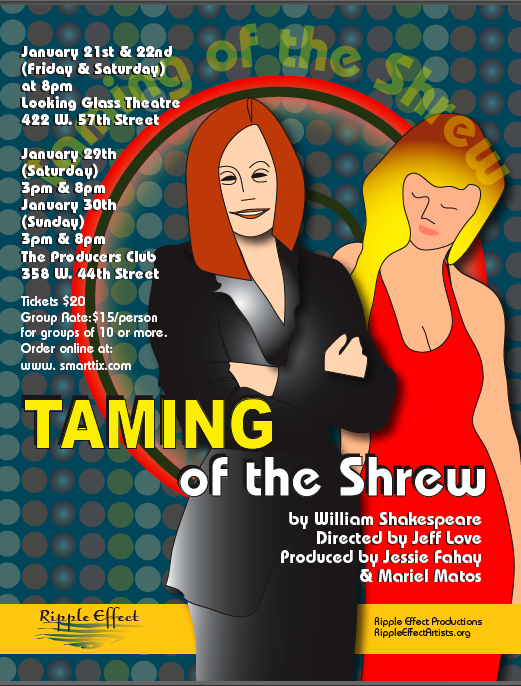
Jessie Fahay, the founder of Ripple Effect Artists, recently spoke to us about her production of The Taming of the Shrew.  By adding a feminist twist to the traditional plot, Fahay hopes to encourage audience members to ask questions, get involved, and raise awareness about important issues affecting women.  In this interview, Fahay speaks about the relationship between theater and activism, gender roles, and her upcoming performances.

What inspired you to launch your performing arts company, Ripple Effect Artists?

I knew that I wanted to start a theatre company that would not only allow me to work with the theatre professionals I chose to work with, but also a theatre company that would make a difference in the community and the world.

What is the significance of your organization’s name?

When a stone is thrown into a body of water, it creates a “ripple effect.”  Our company is that stone that dares to ask our audiences bold questions and make a difference, which will inspire others in their circle to take action.  We are out to create a “ripple effect,” of a more connected, loving, communicative, and compassionate world.

What can the audience expect when coming to see your modern-day, feminist production of The Taming of the Shrew?

A lot of laughter, fun, and phenomenal 80’s costumes!  Really, audiences can expect to feel every range of emotion from extreme joy to extreme terror to extreme sadness.

On your website, you say that the roles of women have changed since Shakespeare’s time, but have also remained the same in some ways.  What differences and similarities do you see between these time periods?

This is a pivotal question.  Differences of course include that women are working, women are the bosses of men, and in many places of the world it is no longer acceptable to inflict physical harm on a woman simply because she is a woman.  Also, there are many organizations (such as Paradigm Shift) that stand for the rights and empowerment of women.  Yet, there are still similarities.  One underlying truth is that as powerful as women can be, women often live in fear—even in the United States as well as many other parts of the world.  There are places of power women still have not obtained (i,e, the President of the United States, most CEO positions, etc, etc.).   In addition, in many places of the world, women are still denied education.

Why did you decide to set your version of The Taming of the Shrew in the 1980’s, rather than the present-day?

This was actually the choice of the brilliant director, Jeff Love.  This came from the thinking that the 80’s was the time in which women were first given powerful roles in the workplace.  Yet, it was still acceptable to make comments about a woman’s attire and to make sexual advances on a woman in the office.  This was a decade of a lot of murkiness when it came to women’s roles in the workplace and at home, which is why it works for this production.

Following some of the performances, there will be a panel discussion with women’s rights activists.  Who will be speaking on this panel and what can the audience hope to gain from this discussion?

There are four different panel discussions—one with employees of Paradigm Shift, one with a leader of a new female-empowerment group, one with a life-coach, and one with a female playwright.  The audience will gain information about these organizations and individuals and what exactly they do as well as gain insights into what differences can be made day-by-day.

When people come watch your performances, they are encouraged to recognize different types of inequality and ask questions.  I think this is great because it puts the audience in an active position to make a difference, in themselves and in society.  How do your performances act as a platform for activism?

Thank you for the recognition.  The answer is in the question.  We challenge our audiences by putting on performances that ask questions (not performances that make statements).  We then further challenge them by asking what differences can be made.

What do you hope the future will bring for Ripple Effect Artists?

For the next five years, Ripple effect will produce one or two shows per year following this format with different issues such as gay-rights, abuse, unrequited love, warfare, etc.  The goal of Ripple Effect is to become an Equity Company in five years with an ensemble of actors, directors, writers, and a staff, with the founder acting as the artistic director.

Finding Feminist History in Finding Oz: A Guest Post by Lincoln Alpern

Where’s the last place you’d expect to unearth a heretofore-unguessed chapter in feminist history? How about a biography of L. Frank Baum, author of the classic fairytale, The Wizard of Oz?

The biography in question is Finding Oz, by Evan I. Schwartz, which my mother and I began reading over the holidays. While the focus is, of course, mainly on Baum himself, Schwartz also describes a lot of the political and social environment of the day, as well as Baum’s own social environment. As part of this, Schwartz devotes a fair amount of time to Baum’s wife, Maud Gage, and her mother, Matilda Joslyn Gage.

I’ve never made a study of American feminist history, and neither I nor my mother had ever heard of Matilda Gage before. We had definitely, however, heard of two of her colleagues, with whom she worked closely on many feminist projects over the years: Elizabeth Cady Stanton and Susan B. Anthony.

Here are some of the highlights of their collaboration, related in Finding Oz:

After the Civil War, when prominent feminists formed the National Woman Suffrage Association—with Stanton as president and Anthony “the corresponding secretary”—Mrs. Gage took the post of chairman [sic] of the executive committee.

Gage defended Anthony in the latter’s trial for attempting to vote in the 1872 presidential election. Four years later, in 1876, she collaborated with Anthony on a major PR stunt at the Centennial Exhibition in Philadelphia, celebrating the hundredth anniversary of the Declaration of Independence.

President Ulysses S. Grant had already rebuffed a formal request by suffragist leaders to read a statement at the celebration. But, like all good citizen-activists before and since, Gage, Anthony, and their three companions (who go unnamed in the book) refused to give up when faced with obstruction by an unenlightened authority.

Instead, they infiltrated the ceremony and, at a suitably dramatic moment during a reading from that selfsame Declaration of Independence, Gage and Anthony stormed the podium. Gage carried a scroll listing the suffragist’s demands, which she passed to Anthony, and which Anthony in turn presented to Vice-President Thomas Ferry, saying, “We present to you this Declaration of Rights of the Women Citizens of the United States.”

The suffragists then made good their escape, though not before scattering leaflets amongst the crowd. These read:

“The Women of the United States, denied for one hundred years the only means of self-government—the ballot—are political slaves, with greater cause for discontent, rebellion and revolution, than the men of 1776 … We ask justice, we ask equality, we ask that all the civil and political rights that belong to citizens of the United States be guaranteed to us and our daughters forever.”

Schwartz describes the event as “an indelible scene in American history,” but neither I nor my mother had an inkling of such an incredible scene ever having taken place.

Following this remarkable feat, Anthony, Gage, and Stanton—mostly the latter two—went on to write the first three volumes of History of Woman Suffrage. Ida Husted Harper later expanded the series by another three volumes. Wikipedia assures me History of Woman Suffrage was “the standard scholarly resource [on the women’s movement] for much of the 20th century,” but again, neither I nor my mother had ever heard of it.

On the specific topic of Matilda Gage, Wikipedia explains she “was considered to be more radical than” her two collaborators, Stanton and Anthony. Schwartz adds that she “fought a more principled fight than either of them.”

It sounds like Gage was one hell of a woman. Apart from being a dedicated feminist activist, she campaigned for the abolition of slavery in the midst of the Civil War (back when Lincoln and the Congress were still trying to make the war about preserving the union, rather than ending slavery). She named her son Thomas Clarkson after an abolitionist, and always took pride that her father’s house was a station on the Underground Railroad.

She also stood for the rights of American Indians, though I’m not familiar enough with the New York Indian tribes she wrote of to judge whether her description of their culture is accurate, or Noble Savage romanticism.

Apart from her work on the first three volumes of History of Woman Suffrage, Gage wrote many articles and books of her own, Woman, Church and State prominently among the latter.

Schwartz paints a picture of a woman whose rhetoric was powerful and robust in writing and in oratory, using juicy descriptive phrases such as “her venomous logic.”

Finding Oz also includes a nice selection of quotes from Matilda Gage, such as this one from the suffrage movement’s third convention in Syracuse, 1852: “There will be a long moral warfare before the citadel yields. In the meantime, let us take possession of the outposts. Fear not any attempt to frown down the revolution.”

She also criticized both Christianity as practiced in this country and the US government, referring at one point to “the tyranny of Church and State” and declaring: “The progress of our movement will overthrow every existing form of these institutions; its end will be a regenerated world.” (In later years, her strident criticism of the Church in the US often put her at odds with other leaders of the movement.)

Matilda Joslyn Gage died on March 18th, 1898. Despite such a dynamic personality and her decades of tireless activism, she has apparently faded from our collective memory. Schwartz points out that she “is rarely mentioned in histories of the [women’s] movement. She remains obscure outside her old hometown, where her house has been designated a landmark by the state of New York.”

This is a shame, as it means students of feminism and the population in general are denied knowledge of a fascinating and inspiring figure of US history.

Lincoln Alpern is an off-and-on college student whose passions include social justice and sci-fi-fantasy literature. He spreads his time about equally between Peekskill, New York, and Yellow Springs, Ohio.
“Polyphonic Feminisms: Acting in Concert”

The Scholar and Feminist Online, a “multimedia, peer-reviewed web based journal… published by the Barnard Center for Research on Women,” is a collection you don’t want to miss!  This fabulous online journal features a wide variety of articles by feminist activists and academic scholars.  The pieces deal with pressing social and political issues, such as diversity and difference within the feminist movement, the need for feminist community, and issues of intersectionality.

Their newest edition, Polyphonic Feminisms: Acting in Concert, focuses on “the need for a diverse many to work – often noisily together.”

“Feminists are often on the forefront of groundbreaking moments, and this issue boasts contributions from many seasoned activists and scholars who make their own activist contributions. All of the contributors wrestle with pressing questions and offer visions of feminist political practices that reflect on failures, problems, and dilemmas, but preserve hope for collective engagement. In a panoply of sound, sight, and text, Polyphonic Feminisms does not demand unity or agreement, but rather allows for a flourishing of ruminations on what feminism is, where it has been, and what paths it might travel forward.” – Catherine Samah

The contributors come from all different backgrounds and each bring their own unique perspectives to the collection.  While reading these articles, I could not help but reflect on my own personal experiences with feminism.  I reflected on my “feminist story” while reading Sarah Ahmed’s article, “Feminist Killjoys (and Other Willful Subjects)” and felt appreciative of the power of my voice while reading Nomy Naam’s article, “Singing as Social Justice.”  The pieces are fun and easy to read, but also thought-provoking and inspiring.

Spring 2011 Prediction: The Paradigm Will Shift by at Least 5%. Spring Events Announced Soon!

We’ll announce our Spring events shortly, so in the meantime please check out our co-sponsored events listed on the event calendar, our blog, and our about page for testimonials and list of past events.

Join us on Facebook, Meetup, and Twitter!

Paradigm Shift NYC events challenge and inspire participants to contribute to the feminist movement by providing a unique and welcoming platform for expression and coalition building.  The result is almost 4 years of feminist community building that is creating both intra- and interpersonal paradigm shifts, contributing to a transformative societal ripple effect.

By donating- you are creating change

Suggested Donations:

$10-25 – will allow one person who is not able to pay to attend an event for free
$50-100- will help subsidize the cost of building a partnership coalition for one event
$100-250- will help subsidize the cost of one venue for one event
$500-750- will help subsidize the costs of event video production

Your donation of $5, 10, $25 or $50+ is greatly appreciated- donate today

Community Speak-Out for Reproductive Freedom

Saturday, January 22nd, 2011 – Celebrating 38 years since Roe v. Wade!

11am – Gather

We need people to help establish the space for the Speak-Out.  We have a permit and need people to help occupy as much space as possible so that the anti-choice forces can’t.

12noon – Speak-Out

Come raise your voice for reproductive justice, to commemorate Roe v. Wade and the bravery of abortion providers in the face of increased terrorism against abortion clinics, and support a local clinic under attack.  See the attached flyer for a full list of demands and more details about the Speak-Out.

Dr. Emily Women’s Health Center
560 Southern Boulevard, South Bronx

#6 Train to E. 149th St.
BX19 Bus to Southern Blvd & 149th

How you can participate:

Organizations-

1) Endorse! Email nycradicalwomen@nyct.net with your organization’s name

2) Forward! Send this to your e-lists

3) Speak out! On 1/22 – all speakers are invited to bring their demands and share their stories connected to reproductive freedom.

Individuals –

1) Forward! Send this to your friends, make announcements at meetings, and help get the word out.  Flyers are also available for leafletting!

2) Join! “Like” the New York Coalition for Abortion Clinic Defense here.

3) Attend! Come early on 1/22 to help us establish our protest area

4) Early birds, if you can’t attend (or even if you can!) we need help calling the media at 6am the morning of the event.

5) Speak out! Come to speak your mind about the reproductive freedom you want to maintain or the abortion provider who made the difference in your life.  Even if you wish to remain anonymous, you can give us a written statement to read on stage so that we can share your support for reproductive rights.

Interested in helping? Email nycradicalwomen@nyct.net or call 212-222-0633

Sponsored by: New York Coalition for Abortion Clinic Defense and Radical Women

Endorsed by: Brooklyn/Queens NOW, Freedom Socialist Party, Socialist Core, World Can’t Wait, National Women’s Liberation, Nieves Ayress Moreno-Trabajadoras por la Paz de NY, Brooklyn Law School National Lawyers Guild chapter.

Jumpstarting Adult Learning with Carrie Lobman

Jumpstarting Adult Learning: How play and improvisation can help you become a better learner (or teacher) with Carrie Lobman

Saturday, January 22, 4:15-5:45pm

920 Broadway, 14th Floor (at 20th Street)

$25.00 in advance, $30 at the door

Click here to register

Lifelong learning is critical to professional and personal success. But for many adults this can be a challenge. As we get older, lots of things get in the way of learning new things — embarrassment, fear of making change, resistance to asking for help, and most of all, a lack of playfulness in our learning environments.  But new discoveries reveal that  playfulness, spontaneity, creativity, performance, and pointless conversation are critical for learning across the lifespan. In this workshop, Carrie Lobman — who has made learning a more joyous experience for thousands of adults — will help participants put play, fun and creativity front and center in even the most serious learning challenges.

Carrie Lobman is director of pedagogy at the East Side Institute, the founder of the Institute’s Developing Teachers Fellowship Program and associate professor at the Rutgers University Graduate School of Education. She is co-author of Unscripted Learning: Using Improvisation Across the K-8 Curriculum and a frequent presenter at professional conferences on learning, development and play, including meetings of the American Educational Research Association, the Association for the Study of Play and the International Society for Cultural and Activity Research.

To register go to: www.acteva.com/booking.cfm?bevaid=214675

or contact Melissa Meyer at 212.941.8906, ext 304, mmeyer@eastsideinstitute.org.

News Flash for NYC Women: Your Health is Important – But Live A Little!

Doctors Susan Love and Alice Domar Distinguish Between the Serious, the Silly and the Superfluous in Women’s Health

January 31st at 8:15 pm: The 92nd Street Y

TICKETS/INFO | www.92Y.org | 212.415.5500 | 1395 Lexington Ave.

PRESS CONTACT | Andrew Sherman | asherman@92y.org | 212.415.5693

New York, NY— Jan. 7, 2011— What are the three ‘must-do’s for breast cancer prevention? Can an old, irritating friend actually be bad for your health – and if so, what do you do about it?  How crucial to your health and happiness is eight hours of un-interrupted sleep?

Doctors Susan Love and Alice Domar, co-authors of Live a Little! Breaking the Rules Won’t Break Your Health, have a message for you: Don’t sweat the small stuff. On Monday, January 31 at 8:15 pm at 92nd Street Y, Drs. Love and Domar help women manage top-of-mind, everyday health concerns, and give them some tips on how to do it without getting even more stressed out. First on the list?  Balancing career, family and exercise when you only have 16 hours a day (if you’re getting those eight hours of sleep, that is).  Also on the agenda: the inescapable companion to modern life – stress – and whether it can actually serve you well (or not).  And, with a peek in the pantry, they talk about importance of berries (and other anti-oxidants) on your shopping list, even in an era belt-tightening.

Dr. Love, author of the famous Dr. Susan Love’s Breast Book (De Capo Press, now in its fifth edition), also looks at breast cancer and what’s changed since the book first came out in 1990, including: breast cancer awareness campaigns (and whether they have been successful); the possibility of a preventative vaccine on the horizon; and how to know the difference between an “interesting” media report on breast cancer and an important one.

Elizabeth Browning, CEO of BeWell.com, a social network focused on health issues and information (founded by Dr. Love and Dr. Nancy Snyderman), moderates the discussion.

Following the talk, Drs. Love and Domar will sign books (which will be on sale at the event).

More About the Speakers

Dr. Susan Love is a professor of surgery at UCLA and President and Medical Director of the Dr. Susan Love Research Foundation. She’s a founder of the National Breast Cancer Coalition; and she was appointed to the National Cancer Advisory Board by President Clinton.  The fifth edition of her book, Dr. Susan Love’s Breast Book, came out in Sept. 2010.

Dr. Domar, a pioneer in the application of mind/body medicine to men’s and women’s health issues, is the executive director of the Domar Center for Mind/Body Health. She’s also a Harvard Medical School professor and a psychologist at Beth Israel Deaconess Medical Center.

About 92nd Street Y

92nd Street Y’s unique fusion of community and culture makes it the only place of its kind in the world. 92Y is a not-for-profit community center, performance stage and lecture hall; a literary salon and home for artists; a school, outreach organization and summer camp; a gym, a residence and more. 92nd Street Y, a proudly Jewish institution since its inception in 1874, has become a community of communities, welcoming people of all ages, races, faiths and backgrounds. Now serving more than 300,000 people each year in its New York facilities, 92Y also reaches millions of “virtual” guests around the world through its website, satellite broadcasts and other electronic media.  Committed to making its programs available to everyone, 92nd Street Y awards nearly $1 million in scholarships annually and reaches about 7500 public school children through subsidized arts and science education programs.  For more information, please visit www.92Y.org

This Sunday: Poetic People Power @ The Art at Bay Gallery!

This Sunday at 3:00 pm, head to the Art at Bay Gallery on Staten Island for an amazing poetry show hosted by “Poetic People Power,” an activist group that uses poetry as a way to raise awareness about important social issues, such as universal health care and consumerism.  Their performances are inspiring, thought-provoking, and life-changing.  Sunday’s show will feature excerpts from their 2009 Show, “Tapped Out: Words About the Water Crisis.Here is a brief description of the show:

Tapped Out: Words About The Water Crisis
On April 25, 2009, we presented Tapped Out: Words About The Water Crisis at Bowery Poetry Club. This show premiered new works about the privatization of water, the dangers facing freshwater, and the growing scarcity of this precious resource. Poets featured were Tara Bracco, Erica R. DeLaRosa, Andy Emeritz, Frantz Jerome, Angela Kariotis, Dot Portella, and Jonathan Walton. Tapped Out marked our seventh annual show.

Email Newsletters with Constant Contact